Oct 28, 2026
Ceramic pad printing is widely used to decorate cups, bowls, plates, saucers, and other ceramic products with logos, patterns, and multicolor designs.
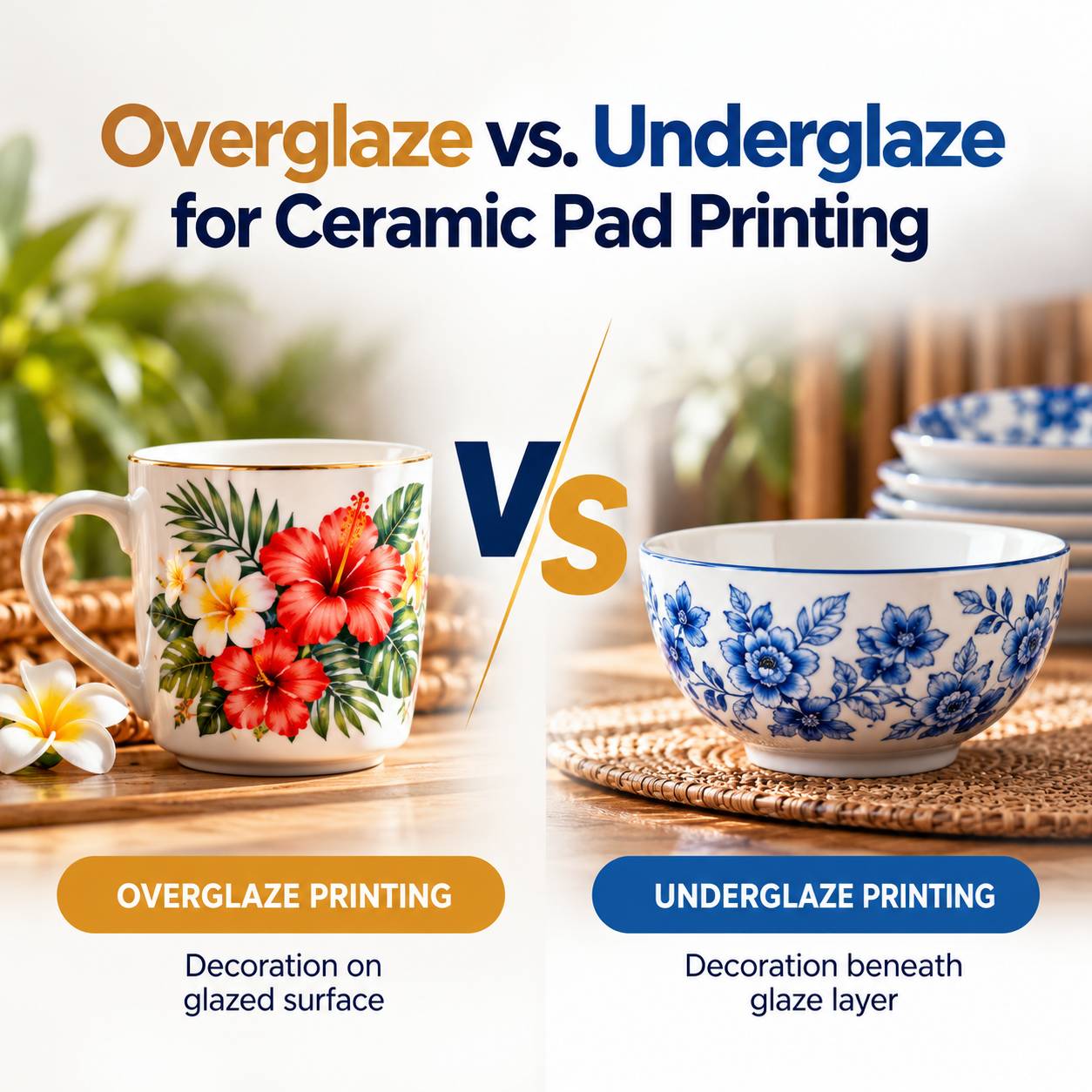
However, not all ceramic printing processes are the same. Two important decoration methods are overglaze printing and underglaze printing. Although both can use pad printing technology, they differ in printing stage, firing temperature, ink requirements, and final surface properties.
Understanding these differences can help ceramic manufacturers choose the right printing process, equipment, and consumables for their production needs.
1. What Is Overglaze Pad Printing?
Overglaze pad printing applies decorative patterns to the surface of ceramic products that have already undergone glaze firing.
The design is transferred onto the glazed ceramic surface using a silicone pad. The decorated product then undergoes an additional firing process to fix the ceramic decoration.
Typical Overglaze Printing Process
Glaze Firing → Pad Printing → Decoration Firing
Overglaze decoration is commonly fired at approximately 600–900°C, depending on the ceramic pigment, glaze, and decoration requirements.
Because the decoration is fired at a lower temperature than many high-fired ceramic bodies, overglaze printing can accommodate a relatively wide range of decorative colors.
Advantages of Overglaze Printing
Suitable for decorating already glazed ceramic products.
Offers relatively flexible color options for decorative designs.
Suitable for logos, decorative patterns, and multicolor applications.
Can be integrated into a separate ceramic decoration stage.
Typical Applications
Overglaze printing can be used for decorative porcelain, ceramic mugs, promotional ceramic gifts, and branded ceramic products.
However, because the decoration remains on the glaze surface, its resistance to abrasion and repeated washing depends on the ceramic ink formulation, firing conditions, and final product quality.
2. What Is Underglaze Pad Printing?
Underglaze pad printing transfers decorative patterns onto an unglazed ceramic body before the final glazing process.
After printing, the ceramic product is covered with a suitable glaze and fired. The decoration becomes positioned beneath the glaze layer.
Typical Underglaze Printing Process
Ceramic Body Preparation → Pad Printing → Glazing → Final Firing
For many high-fired porcelain applications, firing temperatures are approximately 1200–1400°C, although lower-temperature ceramic systems also exist.
Underglaze ceramic pigments must be compatible with the selected glaze and withstand the required firing conditions.
Advantages of Underglaze Printing
The decoration is protected beneath the glaze layer.
Offers good potential for wear-resistant ceramic decoration.
Produces a smooth, glazed surface over the printed pattern.
Suitable for integration into ceramic manufacturing before final glazing.
Typical Applications
Underglaze printing is widely applicable to ceramic tableware, bowls, plates, saucers, and other products requiring decoration beneath a protective glaze.
The final printing result depends on ceramic pigment stability, glaze compatibility, firing conditions, and the quality of the printing process.
3. Overglaze vs. Underglaze Printing: Key Differences
Comparison 对比项目
Overglaze Printing 釉上彩
Underglaze Printing 釉下彩
Printing Surface 印刷表面
Glazed ceramic surface 已烧成的釉面
Unglazed ceramic body 未上釉的胚体
Printing Stage 印刷阶段
After glaze firing 釉烧完成后
Before final glazing 最终施釉前
Typical Firing Temperature 典型烧成温度
Approx. 600–900°C 约600–900°C
Approx. 1200–1400°C 约1200–1400°C
Color Options 色彩表现
Wider range of decorative colors 装饰色彩相对丰富
High-temperature-stable colors 需使用耐高温色料
Durability 耐磨表现
Depends on decoration and firing quality 取决于装饰层及烧成质量
Glaze provides additional protection 釉层提供额外保护
Surface Finish 表面效果
Decoration on the glaze surface 图案位于釉面
Decoration beneath the glaze 图案位于釉层下
Production Process 生产工艺
Glaze firing → Printing → Decoration firing釉烧 → 移印 → 装饰烧成
Printing → Glazing → Final firing移印 → 施釉 → 最终烧成
Typical Applications 典型应用
Gift mugs, decorative ceramics, logos 礼品杯、装饰陶瓷、LOGO
Tableware, bowls, plates 餐具、碗、盘
Best For 推荐选择
Colorful decorative designs 色彩丰富的装饰图案
Long-lasting underglaze decoration 强调釉层保护的装饰
WINNEO Solution
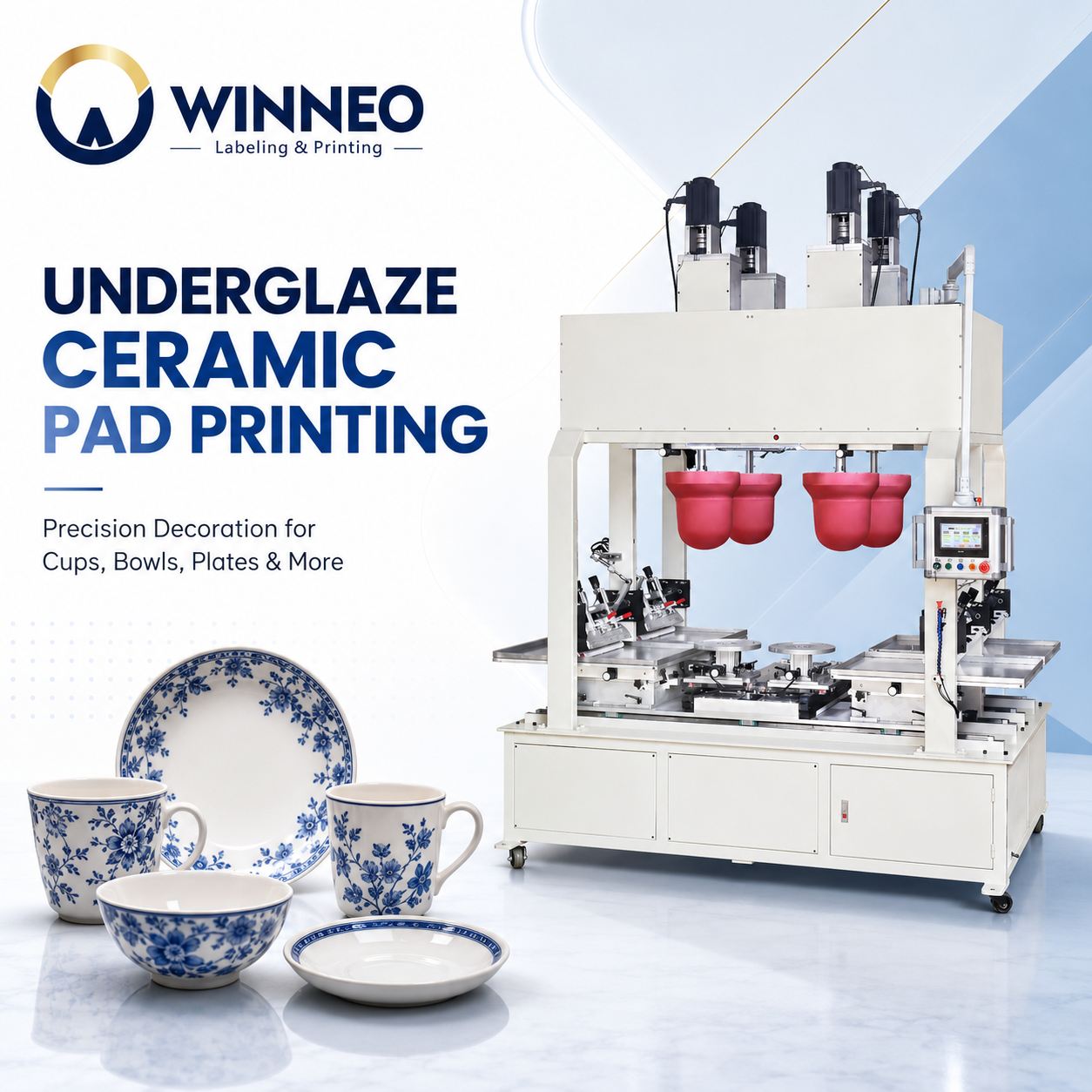
WP-CEREMIC-1 / 2 / 3 / 4
Customized printing solution
4. Ceramic Printing Ink Requirements: Why Do They Matter?
Selecting suitable printing ink is essential for both overglaze and underglaze ceramic printing.
Unlike conventional decorative inks used on plastics or metals, ceramic inks intended for firing must be compatible with the ceramic decoration and firing process.
Overglaze Printing Ink
Some overglaze pad printing applications require specially formulated ceramic inks.
Certain ceramic inks have a thick, paste-like consistency at room temperature. When thermoplastic ink systems are used, a heated ink tray or printing plate may be required to maintain suitable viscosity and ensure stable ink transfer.
Key considerations include:
Ceramic pigment and glaze compatibility.
Ink viscosity and transfer performance.
Firing temperature requirements.
Compatibility with heated printing equipment, when required.
Not all overglaze inks require heating. The ink formulation determines whether a heated system is necessary.
Underglaze Printing Ink
Underglaze printing can use ceramic-specific inks designed for room-temperature pad printing, depending on the formulation.
Suitable ink viscosity and pigment dispersion help achieve consistent ink pickup, release, and pattern definition.
For better compatibility, WINNEO recommends selecting underglaze ceramic inks that have been evaluated for the intended printing equipment and production process.
Even when an underglaze ink can be printed at room temperature, it must still be suitable for the subsequent glazing and firing process.
The right combination of ceramic ink, silicone pad, printing plate, and machine configuration is essential for consistent printing performance.
5. How to Choose Between Overglaze and Underglaze Printing
Choosing the most suitable process depends on your ceramic product and manufacturing workflow.
Choose Overglaze Printing When:
Your ceramic products have already been glazed and fired.
You need to add colorful logos or decorative patterns.
Your production process includes a separate decoration firing stage.
You need a printing solution compatible with your existing glazed ceramic products.
Choose Underglaze Printing When:
Your ceramic products have not yet received their final glaze.
You prefer designs protected beneath the glaze layer.
Your production line includes glazing and final firing after decoration.
Your products require a smooth glazed surface over the printed patterns.
For ceramic tableware intended for food contact, the selected decoration method and finished product must also meet applicable safety and migration requirements.
6. Choosing the Right Ceramic Pad Printing Machine
In addition to selecting the printing process, ceramic manufacturers should evaluate several machine-related factors.
Number of Printing Colors
Single-color, two-color, and multicolor configurations can be selected according to the complexity of the artwork.
Printing Area and Product Dimensions
The machine's printing capacity and fixture design must match the size, shape, and printing position of the ceramic product.
Production Capacity
Required output, loading methods, and printing cycles should be evaluated according to actual production conditions.
Ink and Printing System Compatibility
Different ceramic inks may require different ink trays, printing plates, silicone pads, and temperature-control configurations.
Sample Printing
Testing with the actual ceramic product, artwork, and intended ink is recommended before confirming the machine configuration.
7. WINNEO Ceramic Pad Printing Solutions
WINNEO provides ceramic pad printing equipment solutions for different decoration requirements, including single-color and multicolor printing applications.
Our ceramic printing solutions focus on:
Suitable machine configurations for different printing requirements.
Printing area and fixture matching.
Silicone pad and printing plate selection.
Ink compatibility evaluation.
Sample printing and technical consultation.
Customized equipment configurations for specific ceramic decoration processes.
For applications involving specialized ceramic inks, particularly thermoplastic ink systems, equipment compatibility should be evaluated before production.
8. Frequently Asked Questions
Q1. What is the main difference between overglaze and underglaze printing?
Overglaze printing applies decoration to an already glazed ceramic surface, while underglaze printing applies decoration before the final glaze layer is formed.
Q2. Which process offers better wear resistance?
Underglaze decoration generally benefits from the protective glaze layer. However, actual durability depends on the materials, glaze quality, and firing process.
Q3. Does overglaze pad printing require heated ink?
Not always. Some thermoplastic ceramic inks require heated printing components to maintain suitable viscosity, while other ink formulations may be used without heating.
Q4. Can conventional pad printing ink be used for underglaze printing?
Not without verifying its suitability. Ceramic inks intended for subsequent glazing and firing must be compatible with the required thermal process. Ordinary non-ceramic inks should not be assumed suitable.
Q5. Can one ceramic pad printing machine handle both processes?
This depends on the machine's ink system, temperature control, printing plates, silicone pads, and other specifications. Some applications may require customized equipment.
Q6. What information should I provide when requesting a ceramic pad printing machine?
We recommend providing product photos, dimensions, printing position, artwork, number of colors, production capacity, intended printing process, and existing ink information.
Find the Right Ceramic Pad Printing Solution with WINNEO
Whether you need underglaze printing for ceramic tableware or a customized overglaze printing solution for decorative ceramic products, selecting the right equipment and consumables is essential.
Send WINNEO your ceramic product details, artwork, and production requirements. Our team can help evaluate a suitable pad printing machine configuration for your application.
Contact WINNEO
WINNEO – Your Pad Printing Expert & Custom Solution Partner
With 20 years of experience in the pad printing consumables industry, WINNEO is a China-based source factory committed to providing professional printing solutions for manufacturers worldwide.
We understand that successful pad printing goes beyond the machine itself. Printing quality depends on the right combination of equipment, silicone pads, printing plates, ink systems, and application-specific configurations.
Why Choose WINNEO?
20 Years of Industry Experience
Deep expertise in pad printing consumables and printing applications.
China Source Factory
Direct access to manufacturing expertise and consumables supply, helping customers explore practical and cost-effective solutions.
Customized Printing Solutions
Machine configurations tailored to product shapes, printing areas, color requirements, and production capacity.
Equipment & Consumables Matching
Professional guidance on silicone pads, printing plates, and compatible ink systems to help achieve consistent printing results.
Application-Focused Technical Support
From initial requirement assessment to sample printing and configuration recommendations, we help customers identify a suitable solution for their production needs.
اقرأ أكثر





 IPv6 دعم الشبكة
خريطة الموقع
| XML | مدونة | سياسة الخصوصية
 عربي
 English
 Русский
 Italiano
 Español
 عربي
 한국어
 Türk
 Polski
 ไทย
 Tiếng Việt